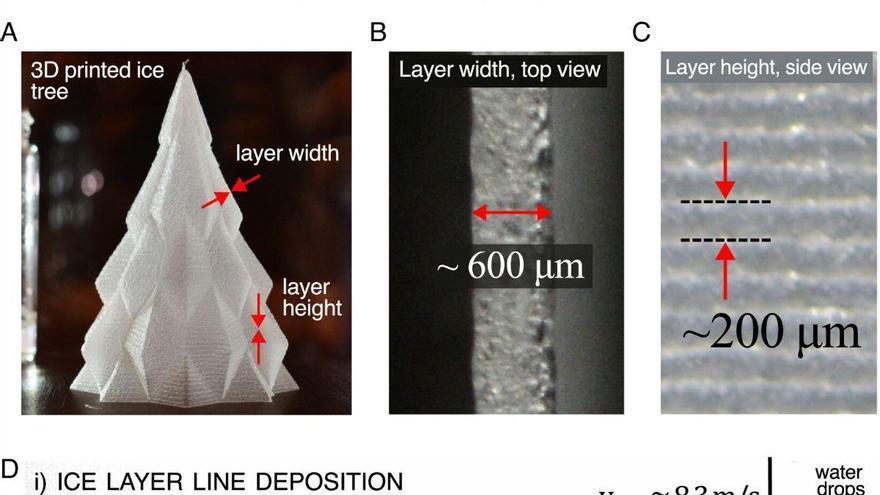
Scientists from the University of Amsterdam, in the Netherlands, developed an innovative method that allows printing three-dimensional structures in ice using "supercooled" water. This breakthrough represents a new application of 3D printing technology in the field of cryogenics.
The technique created by the researchers takes advantage of evaporative cooling in a vacuum chamber to solidify water into precise shapes. This allows creating complex structures without the need for additional support structures.
Among the practical examples of the application are small Christmas trees made in ice, as well as inclined shapes that demonstrate the versatility of the method. The technique has proven capable of producing varied geometries with precision.
The development of this technology opens new possibilities for scientific and industrial applications that require the manipulation of ice structures in a controlled and detailed manner.