Lisbon: "Your pain touches us," said D. Rui Valério to the Ukrainian community
Agência ECCLESIA30 August 2026 at 17:59
The Patriarch of Lisbon, D. Rui Valério, stated that "your pain touches us" during a Prayer Vigil held at the Jerónimos Monastery, in Lisbon, on the occasion of the 35th anniversary of the restoration of Ukraine's independence. The event was promoted by the Chaplaincy of the Ukrainian Greek-Catholic Church in Portugal and the Embassy of Ukraine in Portugal, with the presence of members of the Diplomatic Corps and the Ukrainian community in Lisbon.
In the Vigil's homily, D. Rui Valério asked that Ukraine may live "in peace, security, freedom and dignity," emphasizing that celebrating a nation's independence also means asking "what future we want to offer to the next generations." The patriarch warned that war "destroys buildings, schools, hospitals and cities" and causes a "deeper destruction" that "always happens in the human being," separating families, creating orphans and widows and transforming projects into uncertainty.
D. Rui Valério defended that "a dead person is never just a number," "a wounded person is never just a statistic" and "a terrified child is never just an inevitable consequence," reminding that "every man, every woman, every child has a face, a name, a story" and a dignity that "no political circumstance, no border and no conflict can erase." The patriarch said that the Church's voice must be raised "whenever human dignity is trampled upon," not to "add one more voice to the conflict," but to recall that the dignity of every human being is "inviolable."
The Patriarch of Lisbon stated that the presence at the Vigil is a manifestation of "solidarity deeper than any difference of language, nationality, culture or history," explaining that "when a human being is wounded, something of all humanity is wounded" and "when a mother cries over her child, that pain belongs, in some way, to all of us." D. Rui Valério considered that "every child who can sleep without fear, every family that remains together, every person who returns home is a victory for humanity."
Vigília de oração no Mosteiro dos Jerónimos, por ocasião dos 35 anos da restauração da independência, pediu «paz, segurança, liberdade e dignidade» para o país
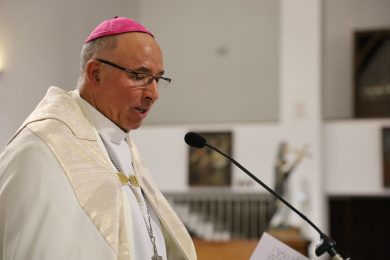
Foto Agência ECCLESIA/PR, Arquivo
Lisboa, 30 ago 2026 (Ecclesia) – O patriarca de Lisboa afirmou hoje que celebrar os 35 anos da restauração da independência da Ucrânia significa celebrar a história de um povo e questionar sobre o futuro a “oferecer às gerações seguintes” que precisa de paz e dignidade.
“Os 35 anos da restauração da independência da Ucrânia, vividos num contexto tão doloroso, são também um apelo à responsabilidade e à esperança. Hoje pedimos que a Ucrânia possa viver em paz, segurança, liberdade e dignidade”, afirmou D. Rui Valério na homilia da Vigília de Oração que decorreu no Mosteiro dos Jerónimos, em Lisboa.
Promovida pela Capelania da Igreja Greco-Católica Ucraniana em Portugal e pela Embaixada da Ucrânia em Portugal, a Vigília de Oração realiza-se no contexto do 35.º aniversário da restauração da Independência da Ucrânia, para pedir a paz para o país.
“O aniversário da independência de uma nação possui também uma dimensão moral. Celebrar a história de um povo não é apenas recordar o que aconteceu; é perguntar o que queremos construir com a liberdade recebida e que futuro queremos oferecer às gerações seguintes”, referiu o patriarca de Lisboa
D. Rui Valério afirmou que rezar pela paz é também colocar-se “ao serviço da dignidade humana”, lembrando que “a guerra destrói edifícios, escolas, hospitais e cidades” e provoca também uma “destruição mais profunda”, que “acontece sempre no ser humano”.
A guerra fere corpos, separa famílias, cria órfãos e viúvas, obriga pessoas a abandonar a sua casa, transforma projetos em incerteza e introduz o medo no quotidiano. E corre um risco terrível: fazer com que a pessoa deixe de ser vista como pessoa”.
O patriarca de Lisboa disse que “um morto nunca é apenas um número”, “um ferido nunca é apenas uma estatística” e “uma criança aterrorizada nunca é apenas uma consequência inevitável”.
“Cada homem, cada mulher, cada criança possui um rosto, um nome, uma história. Cada pessoa possui uma dignidade que nenhuma circunstância política, nenhuma fronteira e nenhum conflito podem apagar”, sublinhou.
“A voz da Igreja deve elevar-se sempre que a dignidade humana é espezinhada. Não para acrescentar mais uma voz ao conflito, nem para aumentar divisões, mas para recordar aquilo que nenhuma guerra pode tornar relativo: a dignidade de cada ser humano é inviolável”, acrescentou.
O patriarca de Lisboa referiu também que a presença na Vigília de Oração é uma manifestação da “solidariedade mais profunda do que qualquer diferença de língua, nacionalidade, cultura ou história”, porque “quando um ser humano é ferido, algo da humanidade inteira é ferido”, “quando uma mãe chora um filho, essa dor pertence, de algum modo, a todos nós” e “quando uma criança cresce entre sirenes e explosões, toda a humanidade tem razões para se interrogar”.
“Esta noite não rezamos por pessoas abstratas ou distantes. Estamos unidos ao povo ucraniano: aos que permanecem no seu país; aos que tiveram de partir; às famílias que Portugal acolheu; aos que cuidam dos feridos; aos que perderam alguém; aos que continuam a esperar; aos que trabalham pela paz. E a todos aqueles que, em qualquer lugar, carregam no corpo ou na alma as consequências da guerra”, disse D. Rui Valério na homilia da Vigília de Oração.
Para D. Rui Valério, o imperativo de construir a paz resulta da certeza de que “cada vida poupada é um bem incomensurável, “cada criança que pode dormir sem medo, cada família que permanece reunida, cada pessoa que regressa à sua casa é uma vitória da humanidade”.
A Vigília de Oração pela Paz na Ucrânia contou com a presença da embaixadores do país, membros do Corpo Diplomático e a comunidade ucraniana presente em Lisboa
The European Union approved Regulation (EU) 2026/1818, regarding the welfare and traceability of dogs and cats, which entered into force on 30 August 2026, although most provisions will only apply from 31 August 2028. Among the main changes are the obligation for prior notification through a European system for those traveling with animals from third countries (from 2036), individual identification by microchip for dogs (2036) and cats (2041), and earlier requirements for commercial operators (2030). The regulation aims to harmonize rules between Member States, improve animal welfare and combat the illegal trade of dogs and cats in the EU.
The article analyzes the conflict situation between Russia and Ukraine, where both countries indicate an imminent military escalation, despite diplomatic negotiations being underway. Commentator Rui Henrique Santos, from CNN Portugal, comments on the strategies of both sides in the conflict that has been ongoing since 2022.
Ireneu Teixeira commented on the situation in Ceuta, stating that migrants brought chaos and disorder to the region. He also analyzed the protests of the local population and the blockages to the Red Cross's work, noting that the daily distribution of humanitarian aid perpetuates the presence of migrants and the crisis situation in the area.
The Traditional Fair of Portela de Alvite celebrates the identity of the rural world, bringing together the parishes of Merufe, in Monção, and Sistelo, in Arcos de Valdevez. The event includes an exhibition and fair of the garrano and cachena breeds, an agricultural contest, a gathering of oxen, horse races, folklore performances, challenge songs, traditional processions and drumming groups.