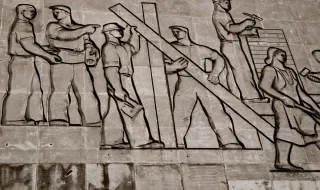
From evangelical prayer mountains to druidic rituals, an enchanted Tijuca Forest, where the religious connect to the sacredPhoto by MELQUIZEDEQUE ALMEIDA on Pexels
WorldLisboa

From evangelical prayer mountains to druidic rituals, an enchanted Tijuca Forest, where the religious connect to the sacred

extra30 August 2026 at 10:30

On the morning of Tuesday, the 18th, a group of pilgrims climbed Monte Cardoso Fontes, located on the banks of the Grajaú-Jacarepaguá highway, in the Southwest Zone of Rio de Janeiro, to perform religious practices in the Tijuca Forest. The faithful were dressed differently from the usual: men in formal attire and women in long dresses or skirts and veils, wearing leather shoes, ballet flats or flip-flops, indicating they were not there for sports hikes, but for prayers. The article mentions that the pilgrims carried gestures, praises and even exotic tongues during the climb.

The newspaper O GLOBO conducted a week-long investigation traveling through different areas of the Tijuca National Park to understand how these spaces were being used for religious practices. The article's title references both evangelical prayer mountains and druidic rituals, suggesting that different religious traditions use the forest to connect with the sacred.

The article also briefly mentions other events in Rio de Janeiro during the same period, including a bus accident on the Serra de Petrópolis that is under investigation and resulted in 10 deaths, as well as an increase in violent deaths in areas disputed between criminal factions, although these topics are not developed in the available excerpt.
Related articles

World

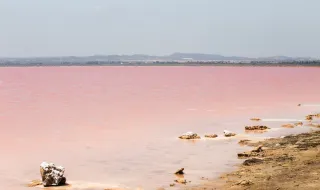
Torrevieja Salt Lake: Looks Like a Scene from the "Barbie" Movie, But It's Very Real (and It's Right Next to Portugal)

The Salt Lake of Torrevieja, in Alicante, Spain, transforms into a vibrant pink setting during summer, particularly between August and September, due to a natural phenomenon involving Dunaliella salina microalgae and bacteria that produce carotenoids under conditions of high salinity and evaporation. The phenomenon, which has even attracted NASA's attention, is part of the Natural Park of the Lagunas de La Mata y Torrevieja, where salt pans managed by the Unión Salinera de España remain active. Visits are free along the trails and viewpoints, with guided train tours available for €12 for adults. From Portugal, there are direct flights to Alicante from €51 from Lisbon and €98 from Porto.

oRegiões30/08/26, 12:15
World

Article by Article

This opinion article from the Jornal do Algarve presents a cynical reflection on the language used in politics and sports, comparing how expressions like "strategic surprises and offensive posture," used by Iran regarding the United States, could easily be applied to football. The author notes how the discourse of footballers and politicians is frequently empty and permissive of multiple interpretations. In a second part, it addresses the issue of plastic recycling in Portugal, criticizing those who demand more recycling without confronting the practical problems of overflowing bins and collection machines at supermarkets, in a clearly ironic tone about the contradiction between demands and practices.

Jornal do Algarve30/08/26, 12:04
World

Bárbara Silva, from Trancoso, fulfills her dream and enters Medicine at Coimbra

Bárbara Silva, a young woman from Trancoso, achieved her dream of entering the Medicine course at the University of Coimbra, having been the best incoming student this year. The Medicine course continues to be the one that requires the highest grade average for admission at Coimbra, making this achievement even more remarkable.

Diário de Viseu30/08/26, 12:00
World

Communist scientists built a Coca-Cola during the Cold War. Today it is a success

During the Cold War, while the United States and its allies consumed Coca-Cola, communist countries created their own versions of the drink. Scientists from the Soviet Union, Romania and other communist countries developed their own cola recipes, often using local ingredients and adapting the taste to local consumer preferences. Some of these products, such as Kvas or Romanian cola, became so popular that they are still consumed today and are considered cultural successes, demonstrating how ideological rivalry extended even to the details of everyday consumption.

CNN Portugal30/08/26, 12:00