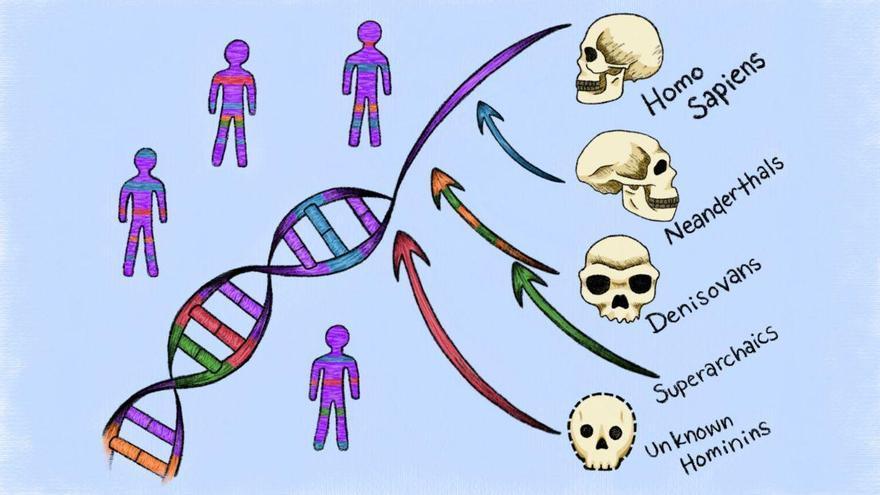
A study led by American researchers identified genetic remains of two vanished human populations in the DNA of modern humans. One of these populations was completely unknown until now, which represents a significant discovery in the field of evolutionary genetics.
The researchers discovered that these "ghost ancestors" contributed genetically to modern humans, leaving marks in our genome that were only now detected through advanced genetic analyses.
The results of this research suggest that the evolutionary history of Homo sapiens is considerably more complex than scientists had previously thought. Rather than a linear progression, human evolution involved multiple interactions between different populations, some of which have not yet been fully characterized.
This study opens new perspectives for understanding how different human groups interacted and mixed over tens of thousands of years, revealing layers of genetic history that were previously hidden.