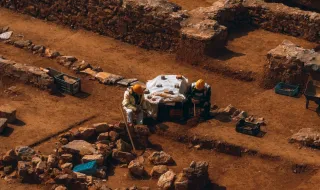
A Roman tried to hide in a giant jar. He stayed there for 1600 years
ScienceSetúbal

A Roman tried to hide in a giant jar. He stayed there for 1600 years

ZAP Notícias4 September 2026 at 11:00

Archaeologists in Bulgaria discovered a human skeleton inside a huge Roman jar at the Roman colony of Deultum. The remains were found on August 10 in a small tower from the late Roman period and may belong to a young Roman who armed himself with two knives during an enemy attack.

It is likely that this person sought shelter inside the giant jar during an enemy attack, more than 1,600 years ago. It is believed that death occurred when a fire swept through the area, destroying the structure where the individual was hiding.

The researchers do not know exactly which battle led to the Roman's death. The discovery was made during archaeological excavations in Bulgaria, a country that was part of the Roman Empire during the period in question.


Related articles

O “pensamento mais feliz” de Einstein passou o primeiro teste no mundo quântico
Science

Einstein's "happiest thought" passed the first test in the quantum world

An international team of researchers announced the first successful observation of the effect of gravity on a quantum object in free fall, in a study published in Science Advances. This experimental result demonstrates for the first time, more than a century after Einstein's prediction in 1907, the link between gravity and the quantum world — the physicist's so-called "happiest thought." However, the researchers emphasize that this experiment does not unify quantum mechanics with gravity, nor does it prove that gravity is a quantum phenomenon, but it provides experimental support for the idea that both domains are connected.

ZAP Notícias05/09/26, 08:00
Science

Medieval manuscripts on animal skin reveal ancient history of deadly virus in sheep

Researchers discovered traces of DNA from a deadly virus that affected sheep thousands of years ago, by analyzing medieval manuscripts made from animal skin. Through advanced genetic sequencing techniques, the team managed to identify the presence of ancient pathogens preserved in the pages of these historical documents, revealing an unprecedented window into the study of viral evolution and diseases that plagued livestock in the Middle Ages.

Euronews Portugal05/09/26, 07:36
Science

How technology is helping archaeology reveal larger and more sophisticated peoples in the Amazon

Recent studies using LiDAR technology have revealed that pre-Columbian civilizations in the Amazon were much more populous and sophisticated than previously thought. A research published in the journal Nature showed that the Aquiry, an ancient civilization in the current state of Acre, may have reached three million inhabitants and built 30 thousand geoglyphs about 2 thousand years ago. Over the past two decades, different studies have revolutionized population estimates for the Amazon, demonstrating that these peoples possessed advanced levels of agriculture and architecture that challenge previous conceptions about the region.

oglobo05/09/26, 07:30
Science

Fertility fatigue: why so many couples give up on treatments and how rest can help | By Ana Luísa Alves

The article addresses the fatigue resulting from fertility treatments, an emotional, physical, and psychological exhaustion that affects many couples undergoing assisted reproduction processes. The piece highlights that between 41% and 42% of women undergoing treatment suffer from anxiety and depression, and that the most difficult moments are follicular puncture and waiting for results. It emphasizes the importance of strategic rest as part of treatment, including intentional breaks and reduction of work overload, arguing that vacation can help break the cycle of hope and frustration, allowing clearer and more balanced decisions.

Postal do Algarve05/09/26, 07:30