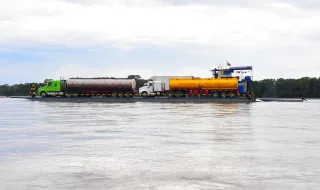
The drought is becoming an economic threat to Europe, with exceptionally low levels of the Rhine and Danube making it difficult to transport goods, putting pressure on the energy sector and creating risks for industries dependent on these waterways. The alert was issued by credit insurer Coface, which considers that the consequences could extend beyond the coming weeks, in a context of weak growth in several European economies.
At the Kaub measurement station in Germany, the Rhine level fell to just 8 centimeters on August 18, well below the 78 centimeters from which navigation begins to be restricted and the previous historical minimum of 25 centimeters recorded in 2018. Some barges on the Rhine were carrying only about 20% of their usual capacity, while on the Danube operators reduced loads by up to 40% in some areas of Romania. The Rhine and the Danube account for about 72% of European river transport.
The pressure extends to the energy sector. The low levels of the Danube are making it difficult for nuclear power plants that depend on the river's water for cooling to operate, namely the Paks plant in Hungary and the Cernavodă plant in Romania, which represent about 40% and 20.5% of electricity production in their respective countries. When production is affected, operators resort to imported electricity, which can cost between two and 2.5 times more than domestically produced electricity, or to gas-fired power plants. The Hungarian and Romanian governments have already adopted temporary measures to reduce industrial electricity consumption.
In Germany, the chemical industry, concentrated along the Rhine, is particularly exposed. The BASF complex in Ludwigshafen is an example, with about 40% of goods transported by barge. Coface warns that during the 2018 drought, Germany's real GDP growth was reduced by between 0.3 and 0.4 percentage points. The current situation occurred earlier and with greater intensity than in 2018, and may not end with the summer, since the period of low Rhine levels usually extends into autumn. For the insurer, diversifying supply chains and the ability to respond to climate disruptions are becoming a matter of economic competitiveness.