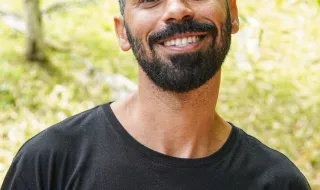
Diogo Amaro, 33 years old, from Vila Verde dos Francos, in the municipality of Alenquer, was a horseman (forcado) for twelve years, making his debut in 2010 in Figueira da Foz and retiring in August 2022 in Alcochete. During that period, he managed to perform between five and nine catches per season, working as the forcado da cara, the man who stands in front of the bull at the start of the catch. Before bullfighting, he dedicated himself to working with animals and cheese production, spending many hours alone on Montejunto mountain, where he began to draw and write in a notebook. A Visual Arts teacher had already told him he had a unique style and should pursue art, but Diogo did not follow that path at the time.
In 2020, at Campo Pequeno, in the midst of the pandemic, Diogo suffered a serious accident during a bull run. The impact threw him about three meters, falling headfirst to the ground without being able to protect himself with his arms. He was taken to Hospital de Santa Maria with a diagnosis of spinal shock, but managed to get up and leave the hospital the next day, considering what happened a "miracle." For about a month, he felt that his body and mind were not responding normally, but he returned to the arenas the following season, deciding to continue until, two years later, he felt it was time to stop.
The pandemic ended up changing the course of Diogo's life. With the impossibility of selling cheese, he decided to dedicate himself to painting more seriously. He began creating works in acrylic, pastel, drawing, and screen printing, also experimenting with materials like adhesive tape and found objects. His studio is currently located in Arruda dos Vinhos, inside an old barbershop from the early twentieth century. His art includes bulls, horses, campinos (bull herders), and forcados, but also family portraits, a series dedicated to fado, and a portrait of Rui Nabeiro. People began to notice his work, commissioning pieces, and gradually, art became his life.
One Sunday, Diogo went to a farm in the municipality of Azambuja to deliver two paintings to the horseman Paulo Jorge Ferreira, when he discovered that a team was collecting testimonies for a documentary production about bullfighting and art. Friends from the Forcados de Turlock, who came from California, convinced him to tell his story, and he ended up being interviewed for about three hours. The project, which will include stories from different countries linked to the bullfighting tradition, is expected to go through a festival before reaching Netflix. Diogo hopes the production will explore the transition between the horseman he was and the artist he is today.