All news
Politics
Business
Technology
Incidents
Sports
Weather
Science
Entertainment
World
Real Estate
AI News
Boredom: why 'doing nothing' may be what's missing from your routinePhoto by mostafa_meraji on Pexels
Science
Space

Boredom: why 'doing nothing' may be what's missing from your routine

oglobo14 September 2026 at 08:00

A study by private network services provider NordVPN reveals that Brazilians spend, on average, 116 hours online per week, placing the country among those that consume the most internet daily in the world. The analysis indicates that out of the 76 years of life expectancy of a Brazilian, 52 will be spent online.

Neurology and psychiatry experts explain that this hyperconnection drastically reduces the opportunity to feel boredom. Despite being uncomfortable, boredom plays an important function in the brain, opening space for a type of "mental cleaning" and operating as a useful trigger for creativity.

According to the research, when we are daydreaming, looking at nothing, gazing out a window, or taking a simple walk without much purpose, we activate an area of the brain called the "default mode network." This set of circuits is linked to memory and thinking.


Why this matters

Excessive time online directly affects Brazilians' mental health, eliminating essential moments for brain rest and creativity. Readers can reflect on their own digital consumption habits and consider incorporating intentional screen-free breaks into their daily routines. WHY: Research on Brazilians' excessive online time provides concrete data on digital habits, allowing readers to assess their own consumption and consider practical changes in their routines to preserve mental health and creativity.

About this summary

This is our short summary of a report published by oglobo on 14 September 2026 at 08:00; the full text stays with the publisher. In our feed it sits under Science. We currently carry 4563 items in that section.

All items in this section →
Source

Related articles

Science

Study reveals humans were already consuming drugs 25 thousand years ago

A study revealed that humans were already consuming drugs 25 thousand years ago, based on two skeletons found in Sulawesi, Indonesia, which present a dental wear pattern compatible with the habit of chewing areca nuts — the oldest drug consumption traces in the world.

Observador14/09/26, 13:15
Science

Climate: Polytechnic University of Coimbra Leads European Project to Make Cities More Resilient

The Polytechnic University of Coimbra will coordinate a European project aimed at developing innovative solutions to make cities more resilient to climate change and other urban challenges. The project has funding from the European Union and involves international partnerships to create tools and strategies that help municipalities adapt to adverse climate conditions, reduce risks, and improve citizens' quality of life.

Notícias de Coimbra14/09/26, 13:07
Science

UPCoimbra leads European project to make cities more resilient to climate change

The University of Coimbra (UPCoimbra) leads a three-year European project focused on making cities more resilient to climate change, through the optimization of sustainable drainage systems and the promotion of integrated water management in cities across several European countries.

Diário de Coimbra14/09/26, 12:58
REGIÃO: Xistos da Beira Baixa com reconhecimento internacional?
Science

REGION: Schists of Beira Baixa with international recognition?

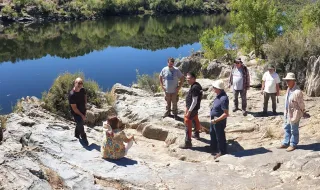
Portuguese and Spanish researchers are studying in the field the oldest rocks of the Beira Baixa territory within the GEOCHRON project, focused on the geochronology of rocks and fossils. During days of field work, scientists visited locations in Geopark Naturtejo, including Segura, Salvaterra do Extremo, Penha Garcia, Rosmaninhal, Monforte da Beira and Perais, preparing a future international scientific excursion.

SAPO Notícias14/09/26, 12:16