All news
Politics
Business
Technology
Incidents
Sports
Weather
Science
Entertainment
World
Real Estate
AI News
From cell phones to educational policies: understand experts' hypotheses for the decline of global leaders in PisaPhoto by Alexas_Fotos on Pexels
Science
Education
Investments

From cell phones to educational policies: understand experts' hypotheses for the decline of global leaders in Pisa

oglobo14 September 2026 at 07:30

The results of the Programme for International Student Assessment (Pisa) revealed a historic drop in learning among developed countries, with declines in Reading and Mathematics at the lowest level ever recorded. Mathias Cormann, Secretary-General of the OECD, presented the data drawing attention to the gravity of the situation. Even countries that were references in education, such as Finland, and new performance leaders, such as Singapore and other Asian nations, recorded significant drops, indicating there are no clear models to reverse the scenario.

Pisa is an international test administered by the OECD every three years that measures student learning in different countries. The program is considered one of the main thermometers of global education and its results serve as a basis for educational policies in various nations.

According to Professor Paulo Blikstein, from Columbia University in the United States, the educational crisis is not due to the fact that schools are not fulfilling their role. For him, factors external to school are making the work of teachers much more difficult and complex, which suggests that the causes of the decline go beyond the traditional school environment.
Why this matters

Pisa is the main thermometer for educational quality in the world and its results affect public policies, school curricula, and the training of millions of students. The unprecedented drop — which reaches even countries previously considered models — indicates that the problem goes beyond the classroom and demands urgent responses from governments and societies. Readers can expect debates about changes in educational policies and technology use by young people in the coming years. WHY: This is the largest drop ever recorded in the main global educational indicator, directly affecting the quality of education your children receive and the future of the country's workforce. Finland, previously a global model, and Asian nations such as Singapore also retreated, showing there are no ready-made recipes to reverse the crisis — experts point out that factors external to school, such as excessive cell phone use, have made teaching more complex. Readers can expect new debates about educational policies and restrictions on cell phone use in schools in response to these data.

About this summary

This is our short summary of a report published by oglobo on 14 September 2026 at 07:30; the full text stays with the publisher. In our feed it sits under Science. We currently carry 4563 items in that section.

All items in this section →
Source

Related articles

Science

Study reveals humans were already consuming drugs 25 thousand years ago

A study revealed that humans were already consuming drugs 25 thousand years ago, based on two skeletons found in Sulawesi, Indonesia, which present a dental wear pattern compatible with the habit of chewing areca nuts — the oldest drug consumption traces in the world.

Observador14/09/26, 13:15
Science

Climate: Polytechnic University of Coimbra Leads European Project to Make Cities More Resilient

The Polytechnic University of Coimbra will coordinate a European project aimed at developing innovative solutions to make cities more resilient to climate change and other urban challenges. The project has funding from the European Union and involves international partnerships to create tools and strategies that help municipalities adapt to adverse climate conditions, reduce risks, and improve citizens' quality of life.

Notícias de Coimbra14/09/26, 13:07
Science

UPCoimbra leads European project to make cities more resilient to climate change

The University of Coimbra (UPCoimbra) leads a three-year European project focused on making cities more resilient to climate change, through the optimization of sustainable drainage systems and the promotion of integrated water management in cities across several European countries.

Diário de Coimbra14/09/26, 12:58
REGIÃO: Xistos da Beira Baixa com reconhecimento internacional?
Science

REGION: Schists of Beira Baixa with international recognition?

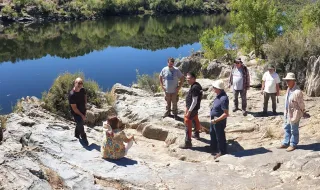
Portuguese and Spanish researchers are studying in the field the oldest rocks of the Beira Baixa territory within the GEOCHRON project, focused on the geochronology of rocks and fossils. During days of field work, scientists visited locations in Geopark Naturtejo, including Segura, Salvaterra do Extremo, Penha Garcia, Rosmaninhal, Monforte da Beira and Perais, preparing a future international scientific excursion.

SAPO Notícias14/09/26, 12:16