All news
Politics
Business
Technology
Incidents
Sports
Weather
Science
Entertainment
World
Real Estate
AI News
Can nuclear fusion save the planet or is it just a money pit?Photo by memyselfaneye on Pexels
Science
Energy

Can nuclear fusion save the planet or is it just a money pit?

Euronews Portugal14 September 2026 at 06:05

Nuclear fusion energy is at the center of an intense scientific debate, with divided opinions on whether this technology could one day replace fossil fuels or if it will remain science fiction. Scientists question whether massive investments in the field are justified or represent merely a waste of financial resources.

The article presents contrasting perspectives: while some experts believe nuclear fusion could be the solution to global energy problems and the climate crisis, others warn that practical advances have been slow and that the costs involved are prohibitive.

The future of fusion energy remains uncertain, with the scientific community divided between cautious optimism and skepticism regarding the economic and technological viability of transforming this energy source into an accessible commercial reality.

Why this matters

Nuclear fusion energy could potentially revolutionize clean energy production in Portugal and Europe, but readers need to understand the risks of investing billions in technology that hasn't yet proven commercially viable. This debate directly affects taxpayers and consumers, as European governments are considering significant funding for fusion projects. The decision to continue or redirect these funds will impact future energy policies and citizens' electricity bills. WHY: none

About this summary

This is our short summary of a report published by Euronews Portugal on 14 September 2026 at 06:05; the full text stays with the publisher. In our feed it sits under Science. We currently carry 4563 items in that section.

All items in this section →
Source

Related articles

Science

Study reveals humans were already consuming drugs 25 thousand years ago

A study revealed that humans were already consuming drugs 25 thousand years ago, based on two skeletons found in Sulawesi, Indonesia, which present a dental wear pattern compatible with the habit of chewing areca nuts — the oldest drug consumption traces in the world.

Observador14/09/26, 13:15
Science

Climate: Polytechnic University of Coimbra Leads European Project to Make Cities More Resilient

The Polytechnic University of Coimbra will coordinate a European project aimed at developing innovative solutions to make cities more resilient to climate change and other urban challenges. The project has funding from the European Union and involves international partnerships to create tools and strategies that help municipalities adapt to adverse climate conditions, reduce risks, and improve citizens' quality of life.

Notícias de Coimbra14/09/26, 13:07
Science

UPCoimbra leads European project to make cities more resilient to climate change

The University of Coimbra (UPCoimbra) leads a three-year European project focused on making cities more resilient to climate change, through the optimization of sustainable drainage systems and the promotion of integrated water management in cities across several European countries.

Diário de Coimbra14/09/26, 12:58
REGIÃO: Xistos da Beira Baixa com reconhecimento internacional?
Science

REGION: Schists of Beira Baixa with international recognition?

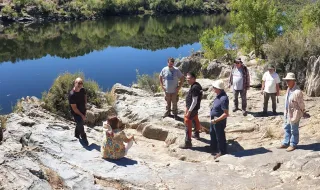
Portuguese and Spanish researchers are studying in the field the oldest rocks of the Beira Baixa territory within the GEOCHRON project, focused on the geochronology of rocks and fossils. During days of field work, scientists visited locations in Geopark Naturtejo, including Segura, Salvaterra do Extremo, Penha Garcia, Rosmaninhal, Monforte da Beira and Perais, preparing a future international scientific excursion.

SAPO Notícias14/09/26, 12:16