All news
Politics
Business
Technology
Incidents
Sports
Weather
Science
Entertainment
World
Real Estate
AI News
Science finds new evidence that Venus may have harbored life in the pastPhoto by geralt on Pexels
Science

Science finds new evidence that Venus may have harbored life in the past

Meteored Portugal13 September 2026 at 11:07

A new investigation published in the journal Earth and Planetary Science Letters suggests that certain fractures on the surface of Venus may preserve traces of ancient oceans. The study is based on radar images obtained by the Magellan mission, where networks of polygons may correspond to sediments that contracted after accumulating underwater.

The discovery reopens questions about the habitability of the neighboring planet, although researchers emphasize that this does not prove that Venus harbored life. The idea still requires additional measurements capable of distinguishing specific materials to be confirmed.

The article calls for the need to separate three distinct questions: whether there was liquid water on Venus, whether habitable conditions existed on the planet, and whether life emerged. These questions are often confused in discussions on the topic.

This investigation joins other recent studies that point to evidence of possible life in Venus's past, renewing scientific interest in a planet that was long considered too hostile to host any form of life.
Why this matters

This discovery is of interest to Portuguese and European audiences because it represents an advance in understanding planetary evolution and reinforces the role of European science in space exploration, in addition to contributing to the broader debate on the search for life beyond Earth, a topic that generates growing public and scientific interest in the region.

About this summary

This is our short summary of a report published by Meteored Portugal on 13 September 2026 at 11:07; the full text stays with the publisher. In our feed it sits under Science. We currently carry 4501 items in that section.

All items in this section →
Source

Related articles

Science

Can sitting in the same place always say something about your personality? Find out

The recurring choice of the same seat to sit — with family, at work, or among friends — can reveal psychological needs such as the search for familiarity, control, and territoriality. The occupied position can also reflect the person's social role in the group: sitting at the head of the table suggests greater central participation, while the sides allow for observation and less exposure. However, experts warn that the preference may have practical explanations, such as comfort, lighting, or proximity to someone, and is not sufficient to define personality.

oglobo13/09/26, 13:58
Science

Innovative surgery in Santa Maria. Patients with pulmonary hypertension no longer have to go abroad

Santa Maria Hospital in Lisbon now performs surgeries for patients with chronic thromboembolic pulmonary hypertension, a serious form of the disease previously only treated in the United Kingdom. This innovation allows Portuguese patients and their families to no longer be obligated to travel abroad to receive treatment.

RTP Notícias13/09/26, 13:50
Science

New doctors from UC "ready" to add value to society

For the first time, the University of Coimbra held an event exclusively dedicated to the investiture of new doctors, a symbolic and festive moment that allowed not only to celebrate the academic achievements of the new doctors, but also to underline the importance of research for society. The new doctors were highlighted as prepared to add value to the community through their scientific work.

Diário de Coimbra13/09/26, 12:15
Cozinhar já era uma forma de arte na Idade do Bronze, revela estudo
Science

Cooking was already an art form in the Bronze Age, study reveals

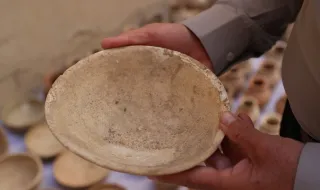
A study conducted by Danish researchers revealed that cuisine in Syria 4,500 years ago, during the Bronze Age, was already surprisingly sophisticated. Recipes based on goat, cereals or gazelle were cooked slowly in clay pots, demonstrating advanced culinary techniques for the time.

SAPO Notícias13/09/26, 11:59