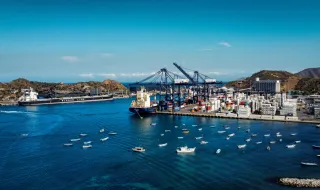
Air Europa resumes direct Madrid-Caracas flights starting September 1Photo by keulefm on Pexels
Business

Air Europa resumes direct Madrid-Caracas flights starting September 1

Jornal Económico1 September 2026 at 13:27

The Spanish airline Air Europa resumed on Tuesday direct flights between Madrid and Caracas, with five weekly frequencies, after having interrupted regular operation for about two months due to earthquakes that affected the Venezuelan airport in June.

The company was forced to change its operation after the double earthquake registered in Venezuela on June 24, which damaged the facilities of Simón Bolívar International Airport in Maiquetía. During this period, Air Europa used Arturo Michelena International Airport in Valencia as an alternative to maintain connectivity with the country, being the Spanish airline that most quickly adapted its operation.

With the full reopening of Simón Bolívar, the special connection via Valencia was closed and flights were resumed on the direct route between Adolfo Suárez Madrid-Barajas airport and Simón Bolívar International Airport. Flights are scheduled for Tuesdays, Thursdays, Fridays, Saturdays, and Sundays, operated with Boeing 787 Dreamliner.

Air Europa, member of the SkyTeam alliance with more than 60 aircraft and based at Madrid-Barajas hub, operates the Caracas route to more than 60 destinations, highlighting its commitment to sustainability and punctuality.


Related articles

Business

UC investigation links psychological characteristics to financial decisions in Portuguese SMEs

An investigation by the University of Coimbra reveals that psychological characteristics of managers, particularly 'mindfulness', have a significant impact on the financial decisions of Portuguese small and medium-sized enterprises. The study demonstrates that mindfulness practice is associated with more prudent liquidity and debt policies, directly influencing the financial management of SMEs. This research contributes to a better understanding of how psychological factors affect business behavior and may have important implications for the training of managers and entrepreneurs in Portugal.

Diário de Coimbra01/09/26, 14:15
Business

JOM Group Strengthens Industrial Capacity, Real Estate, and Commercial Network in 2026

The JOM Group is executing in 2026 one of the largest investment cycles in its history, three decades after its founding, focusing on strengthening industrial capacity, valuing the real estate portfolio, and modernizing the commercial network. In the industrial area, the expansion of Polo I in Guimarães stands out with an investment of approximately 2 million euros, which will increase production capacity by 20%. In real estate, the group transformed assets into commercial spaces such as Corroios Retail Park and Batalha Retail Park, with new projects planned for Maia, Castelo Branco, and Chaves. The commercial network was renovated in six stores and e-commerce grew more than 22% in the first semester. The group currently operates with 28 stores and approximately 500 employees.

Jornal Económico01/09/26, 14:07
Business

Gulf economies continue under pressure six months after war with Iran, says DBRS

The economies of Gulf countries continue to suffer uneven impacts six months after the start of the war with Iran, with Kuwait, Qatar and Bahrain among the most affected, according to an analysis by DBRS Morningstar. The conflict and restrictions in the Strait of Hormuz have penalised the GCC economies differently, at a time when uncertainty remains high following the end of the ceasefire between the US and Iran. While the United Arab Emirates, Saudi Arabia and Oman have resisted better due to their lower dependence on the Strait of Hormuz, the most affected countries are expected to record sharp slowdowns or declines in real GDP in 2026. Increased oil production, public spending and support measures have helped cushion the impact, but exports remain below pre-conflict levels. DBRS considers the risks to the economic outlook to remain high, warning of the possibility of conflict escalation and the potential closure of the Bab el-Mandeb Strait.

Jornal Económico01/09/26, 14:07
Business

Fake goods, real danger: the €83 billion business behind illicit trade in Europe

A European investigation reveals that the trade in counterfeit goods in Europe moves around €83 billion annually, fueled by organized crime networks that infiltrate legal markets. Investigators warn that many consumers, when acquiring these products without knowing their fraudulent origin, are involuntarily financing criminal activities, including human trafficking and mafia organizations. European police have intensified operations to combat this clandestine industry, but the complexity of distribution chains makes the fight particularly challenging.

Euronews Portugal01/09/26, 14:00