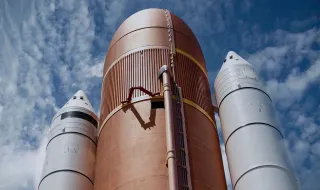
Nancy Grace Roman Telescope is already in space to help some of the greatest mysteries of astrophysics and cosmologyPhoto by Alexis B on Pexels
Science
Инвестиции
Космос

Nancy Grace Roman Telescope is already in space to help some of the greatest mysteries of astrophysics and cosmology

TVI Notícias30 August 2026 at 22:09

The Nancy Grace Roman space telescope was launched into space and is now operational to investigate some of the biggest mysteries of astrophysics and cosmology. This telescope represents an important milestone in space exploration and in the understanding of the universe.

With dimensions similar to those of a bus, Roman is a large instrument that will allow unprecedented observations of the cosmos. Its size allows a light-gathering capacity and resolution that surpasses many previous telescopes.

The investment in this project reached approximately 3.7 billion euros, reflecting the scientific and technological ambition behind this mission. This substantial funding demonstrates the commitment of space agencies to investigating the mysteries of the universe.

Scientists expect the Roman telescope to revolutionize the way we observe and understand the universe, opening new windows for the study of cosmic phenomena that have long remained inaccessible to human observation.


Related articles

Parem de mentir: faríamos filhos mais inteligentes, se pudéssemos
Science

Stop lying: we would make smarter children if we could

A study published in the journal Nature Human Behaviour, with more than 2,000 participants from the United States and China, revealed that non-medical characteristics related to intelligence and behavior, such as low IQ or antisocial behavior, weigh in the choice of embryos for in vitro fertilization (IVF) almost as much as the risk of disease, contradicting what many people may claim.

ZAP Notícias30/08/26, 23:30
Science

Young 17-year-old solves mathematical enigma over a century old and discovers 85 new geometric shapes

Connor Hill, a 17-year-old student from Pennsylvania, solved a mathematical enigma that had been open for over 150 years by proving the exact existence of 146 isolated noble polyhedra, discovering 85 new three-dimensional shapes unknown to science. By developing an algorithm that combines algebraic reduction with computational verification, Hill transformed a virtually infinite search into a finite set of testable equations. The complete proof was published on the academic repository arXiv, confirming that the list of these polyhedra - figures of high complexity where all faces and vertices are exactly equal by symmetry - is finally complete. The feat earned him first place in the Regeneron Science Talent Search 2026, the most prestigious science competition for secondary school students in the United States, with a prize of $250,000.

oRegiões30/08/26, 22:22
Science

NASA's most powerful observatory is already in space

NASA's new Nancy Grace Roman space telescope is already in orbit, representing the most powerful observatory ever launched by the space agency. This telescope promises to revolutionize the observation of the universe with its advanced wide-field imaging technology.

RTP Notícias30/08/26, 22:10
O nosso músculo mais rápido está… nos olhos
Science

Our fastest muscle is... in our eyes

The muscles that control and protect the eyes are the fastest in the human body. Although they are not the strongest, these small muscles are extraordinary in terms of speed and endurance, allowing rapid and precise eye movements, as well as protective functions such as blinking.

ZAP Notícias30/08/26, 21:30