All news
Politics
Business
Technology
Incidents
Sports
Weather
Science
Entertainment
World
Real Estate
AI News
Sweden: company finds new creative uses for decommissioned wind turbinesPhoto by moerschy on Pexels
Technology

Sweden: company finds new creative uses for decommissioned wind turbines

Euronews Portugal13 September 2026 at 06:05

A company in Sweden is finding creative ways to give new life to decommissioned wind turbines and blades. Instead of discarding them, the company transforms these components into buildings, offering a sustainable solution to the wind energy waste problem.

The fate of decommissioned wind turbines and blades has been a growing concern as more turbines reach the end of their useful life. The Swedish approach represents an innovative alternative to simple disposal.

This project in Sweden demonstrates how renewable energy infrastructure elements can be repurposed in unexpected ways, contributing to a more circular economy in the energy sector.


Why this matters

This innovation is of interest to readers concerned with sustainability and waste management, especially wind infrastructure owners and environmental decision-makers in Sweden and other countries with wind farms, given the growing number of turbines reaching the end of their useful life in the coming decades.

About this summary

This is our short summary of a report published by Euronews Portugal on 13 September 2026 at 06:05; the full text stays with the publisher. In our feed it sits under Technology. We currently carry 4282 items in that section.

All items in this section →
Source

Related articles

Technology

AI Leaders Admit to Slowing Down More Advanced Models

Leaders of the largest artificial intelligence companies admit the need to slow down the development of the most advanced models given the growing security risks. Dario Amodei, CEO of Anthropic, proposed external evaluations with access similar to that of internal teams, a measure supported by Sam Altman and Elon Musk, clarifying that the proposal does not imply suspending model training, but creating time to test and protect the technology. Demis Hassabis, from Google DeepMind, considered the guidance correct, although he argues that the details still need to be defined. Any eventual coordination faces competitive and geopolitical obstacles, given that American companies compete for customers and market share among themselves and with Chinese groups, and it remains uncertain whether competition authorities would accept a coordinated slowdown.

Eco13/09/26, 13:39
Technology

Clucky is an app for people who need to "rise with the chickens" and has challenges to get them out of bed

The Clucky app was created for people who have difficulty waking up in the morning, offering an alternative to traditional alarm clocks that are often turned off and lead to going back to sleep. The app works through challenges and missions that the user needs to complete before being able to silence the morning alarm, thus encouraging a more active and conscious wake-up routine.

SAPO Tek13/09/26, 13:10
Como é que o Wi-Fi atravessa paredes? E porque é que algumas paredes o destroem?
Technology

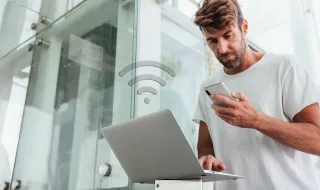
How Does Wi-Fi Go Through Walls? And Why Do Some Walls Destroy It?

Wi-Fi doesn't go through walls without consequences: the signal loses energy, is absorbed, reflected and deflected by the materials it encounters. Materials like concrete, brick, metal and even water absorb or block most of the signal, while plaster, wood and glass let it pass with less loss. The signal frequency also influences things: higher frequencies (like 5 GHz) offer more speed but attenuate more quickly through obstacles, while lower frequencies (2.4 GHz) penetrate better but with less bandwidth.

SAPO Notícias13/09/26, 13:00
Technology

Polytechnic University of Coimbra leads European project for cities more resilient to climate change

The Polytechnic University of Coimbra will coordinate the European project ResSuDSCita, with a 36-month duration and funding of approximately 968 thousand euros, aimed at developing sustainable urban drainage solutions to help cities face climate change and extreme weather events. The project, which brings together partners from Portugal, Greece, Poland, Hungary and Sweden, includes Águas de Coimbra in the implementation of pilot solutions and includes the creation of digital models with sensors, remote monitoring, artificial intelligence and machine learning. One of the most innovative aspects is the incorporation of industrial by-products in drainage infrastructures, applying circular economy principles to reduce the consumption of raw materials and transform waste into resources.

Campeão das Províncias13/09/26, 12:46