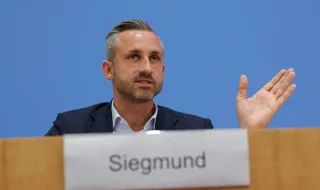
The far-right party Alternative for Germany (AfD) won Sunday's elections in Saxony-Anhalt, an eastern federal state of Germany, obtaining 44.3% of the votes, a historic result that is transforming the country's political landscape. With 97% of the votes counted, the AfD fell just three seats short of an absolute majority of 42 mandates, meaning it will not be able to govern alone, as no far-right party has come to power in Germany since 1945.
The AfD's candidate for the position of prime minister, Ulrich Siegmund, declared that "this is a historic night" and that the party has "a mandate to govern." Co-leader Alice Weidel stated that "with Uli Siegmund, you have the first president of Germany," while Tino Chrupalla indicated that they intend to take responsibility for governing in Saxony-Anhalt and also at the federal level after the 2029 general elections. In the 2025 federal elections, the AfD became the second-largest party nationally.
The candidate of the Christian Democratic Union (CDU), Sven Schulze, expressed disappointment with his party's result, which saw its vote share cut in half to 17%, compared to 2021, acknowledging that it suffered "a hard blow." The Greens obtained about 8.9% of the votes, The Left party got 8.5%, the Sahra Wagenknecht Alliance (BSW) achieved 5.2% by a narrow margin, and the FDP failed to enter the regional parliament.
The CDU reiterated that it cannot have serious conversations with a party that "has a serious problem with antisemitism," while the leader of The Left's parliamentary group stated that the CDU must decide "on which side of history it stands." With the BSW entering parliament, the absolute majority became even more distant for the AfD, but the CDU, The Left, the Greens, and the SPD also lack a majority, making the BSW potentially decisive. It is possible that Ulrich Siegmund will be elected prime minister in a third vote in parliament, where he would only need a simple majority.