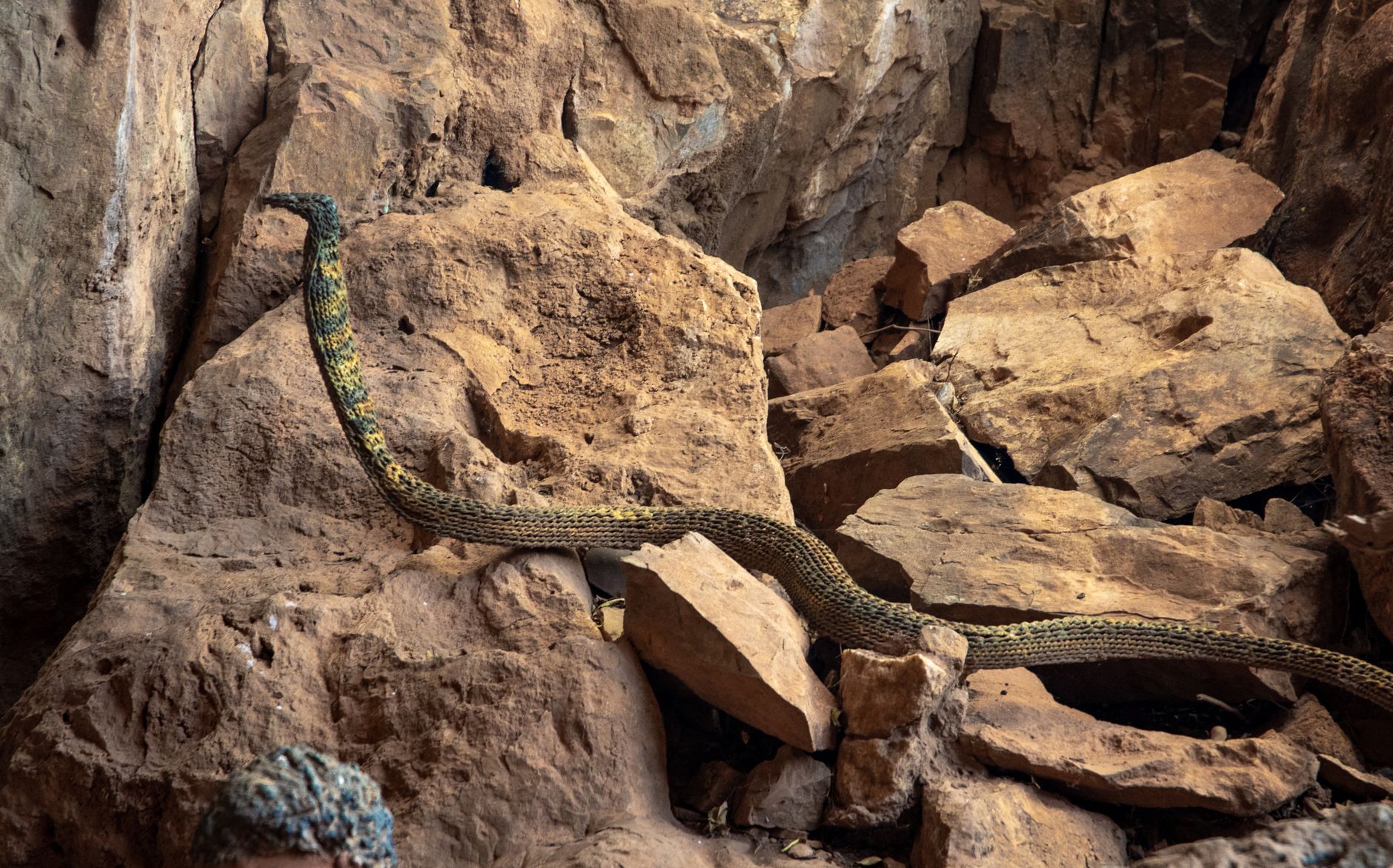
What species is this: ladder snakePhoto by Magda Ehlers on Pexels
ScienceAveiro

What species is this: ladder snake

Wilder4 September 2026 at 15:13

Reader Alexandre Henriques spotted a snake on August 29 in Águeda, Aveiro, and contacted Wilder to find out which species it belonged to. The reader explained that the snake appeared in his house, having been placed in the backyard, and that the animal tried to bite.

The identification was made by Diogo Parrinha, herpetologist and PhD student at BIOPOLIS/CIBIO. It is a ladder snake (Zamenis scalaris), completely harmless and non-venomous.

This species can reach 160 centimeters in length and is the second snake with the largest distribution area in Portugal, only surpassed by the horseshoe whip snake. It is well distributed throughout the Portuguese mainland territory, especially up to 800 meters altitude, being easier to observe between April and October. Its preferred habitat is open oak or cork oak woodlands, as well as agricultural landscapes, where it seeks vegetation along rivers and edges and walls that divide the cultivated fields.

Ladder snakes face significant threats, including being run over, as they seek the heat retained in the asphalt at night to warm up, and the destruction of their natural habitat.


Related articles

Science

Is blended soup really healthy? - Your question

This article explores the question of the healthiness of blended soup, questioning what happens to the fiber of vegetables when they are blended and whether a velvety soup has the same nutritional impact as fruit juice. Nutritionist Mariana Chaves is invited to clarify these doubts about the benefits and possible nutritional losses of blended soup.

Observador04/09/26, 16:36
Science

Is peeing after sex good or bad?

The article addresses whether urinating after sex is beneficial or harmful for women, explaining that burning and genital pain are frequent complaints among them. The proximity between the bladder, urethra, and vagina, together with friction during penetration, facilitates the displacement of bacteria into the urethra and bladder, which can cause urinary infection, candidiasis, cystitis, and chlamydia. Experts recommend urinating after sexual relations as a way to "wash" the urethral canal and eliminate bacteria that may have entered during the act.

oglobo04/09/26, 16:11
Vive 271 dias com um rim de porco: transplante bate recorde e abre caminho para alternativa à diálise
Science

Lives 271 days with a pig kidney: transplant breaks record and opens path to dialysis alternative

Tim Andrews, 66, received a genetically modified pig kidney at Massachusetts General Hospital in the USA in January 2025, after suffering from end-stage kidney disease caused by type 2 diabetes. The transplant broke a record by functioning for 271 days, offering significant hope as an alternative to dialysis and the long wait for human kidneys, which can exceed seven years. This milestone represents a promising advancement in transplant medicine and the search for solutions to organ shortage.

SAPO Notícias04/09/26, 16:11
Projeto MOPPA para Monitorização de Bivalves
Science

MOPPA Project for Bivalve Monitoring

The Portuguese Institute for the Sea and Atmosphere (IPMA) has been conducting bivalve bank monitoring campaigns along the oceanic coastline of mainland Portugal for about four decades, as part of the Small-Scale Fisheries and Gathering Monitoring Program (MOPPA), which have been ongoing since 1986 and allow for the assessment of the state of these marine resources.

SAPO Notícias04/09/26, 15:57