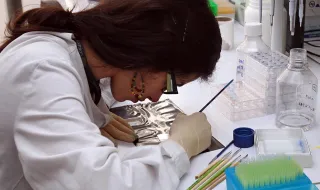
The Breast Cancer Clinical Research Unit at the Centro Nacional de Investigaciones Oncológicas (CNIO) identified a new protein involved in cancer, osteopontin, through studies in mice. This discovery represents a new therapeutic pathway for the treatment of breast cancer.
The osteopontin protein functions as a new target that, when blocked, can enhance the effectiveness of antiangiogenic treatments. These medications act by preventing the creation of new blood vessels, which are necessary to nourish and grow tumors.
Furthermore, the researchers found that acting against osteopontin could also contribute to enhancing immunotherapy, thus offering a complementary approach in the fight against cancer.