Iran: Energy shock 'has not yet ended' and AI increases energy demand, says IMFPhoto by Anton Kudryashov on Pexels
Business
Энергетика

Iran: Energy shock 'has not yet ended' and AI increases energy demand, says IMF

Jornal Económico2 September 2026 at 07:46

The director of the International Monetary Fund (IMF), Kristalina Georgieva, warned that the energy shock resulting from the closure of the Strait of Hormuz "has not yet ended" and that the development of artificial intelligence is increasing energy demand. These statements were made on Tuesday, September 1st, at the end of the meeting of G20 finance ministers and central bank governors in Asheville, North Carolina. Georgieva noted that the Strait of Hormuz remains mostly closed, that strategic oil and gas reserves will need to be replenished, and that winter is approaching in the northern hemisphere.

Georgieva stated that the global economy absorbed the energy shock "better than expected", contrasting it with the "increase in AI investment", which "boosted growth" in the US, South Korea, and other countries in the value chain, including electricity production projects to meet energy needs. However, she noted that there is a "significant divergence" between economic trajectories and that risks to global growth prospects, stabilized at around 3%, remain high.

Among the main risks listed, in addition to the continuation of the energy shock, the increase in public debt stands out, which, according to Georgieva, "exceeds the peaks recorded after World War II", approaching 100% of GDP worldwide. The official also stated that the disinflation process has stagnated in many countries, that growing fiscal pressures are driving up benchmark bond yields, and that the impact of AI on productivity and financial stability "is shrouded in uncertainties".

Georgieva emphasized that the priorities of economic policy "are clear" and urged central banks to focus on price stability and fiscal authorities to "agree on credible medium-term consolidation plans". She stressed that structural policies should focus on reducing bureaucracy and removing obstacles to growth, arguing that greater growth potential would help solve the fiscal problem and vice-versa.

Related articles

Visita del ministro de Industria a Ascer
Business

Visit of the Minister of Industry to Ascer

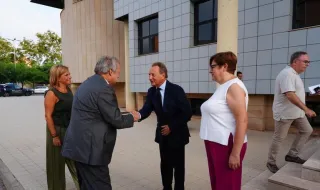
The Minister of Industry visited the facilities of the Spanish Association of Ceramic Manufacturers (Ascer), where he learned firsthand about the activities and facilities of the employers' association for the ceramic sector. During the visit, the head of the Industry portfolio had the opportunity to become familiar with the functioning and needs of this Spanish industrial sector.

El Periódico Mediterráneo - General02/09/26, 09:25
Business

Shein loses 75% of its value in four years and shares fall 10% on Hong Kong debut

Shein debuted on the Hong Kong stock exchange with a 10% drop in shares, a moment that exposed the enormous gap between the company's expectations in 2022 and its current financial reality. The operation valued the company at approximately 26 billion dollars, far below the 100 billion it was valued at four years ago, representing a 75% loss in value. Founder Chris Xu saw his fortune fall from over 23 billion to around 8 billion dollars. The company faces significant challenges, including new European fees on low-value orders, rising logistics and distribution costs, and revenue growth of only 1% in the first quarter. Analysts question whether the IPO valuation is sustainable, given that Shein presents lower margins than competitors and potentially high valuation multiples relative to current results.

Jornal Económico02/09/26, 09:24
El Ibex se gira al alza y avanza un 0,2% pese a la tensión en Oriente Próximo
Business

The Ibex turns upward and advances 0.2% despite tension in the Middle East

The Ibex 35 reversed its negative trend and advanced 0.20% on Wednesday, to 19,864.60 points, after starting the session in negative territory. The Madrid index opened with a decline of 0.17%, to 19,790 points, initially losing the 19,800 level it had managed to maintain on Tuesday despite closing with a 0.75% decline. Market evolution continues to be marked by the escalating tension in the Middle East after the exchange of attacks between the United States and Iran, a situation that continues to push oil prices upward. The Brent barrel remains near 95 dollars.

El Periódico Mediterráneo - General02/09/26, 09:17
Business

Foreign investment in the real estate sector has slowed. Why?

Foreign investment in the Portuguese real estate sector reached 1.7 billion euros in the first half of 2026, a reduction of 10.5% compared to the 1.9 billion euros in the same period in 2025, according to data from the Bank of Portugal. The slowdown results from a combination of factors: global geopolitical uncertainty, rising interest rates, significant appreciation of Portuguese properties that reduced competitive advantage compared to other European countries, scarcity of quality product and less fiscal and regulatory predictability. Although the stock of foreign direct investment in Portugal still represents 71% of GDP, investors have become more prudent and demanding, comparing Portugal with markets such as Spain, Italy and Greece. The article warns that, although Portugal maintains strong arguments such as security and quality of life, it can no longer rely on the idea of being a cheaper European alternative, needing to accelerate licensing and ensure regulatory stability to maintain attractiveness.

Jornal Económico02/09/26, 09:17