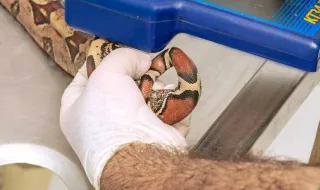
The reader Lisa found a marine animal on August 14, 2026 on a beach on the Alentejo coast, inside a pool of water about 1.5 meters deep among rocks. When trying to check if there was anything inside the shell, the animal released a very strong purple ink, confirming it was alive. The reader sent photographs and questions to Wilder about the species, asking whether it would be vulnerable or endangered.
Expert Gonçalo Calado, a professor at the Universidade Lusófona, identified the animal as being Epitonium clathrus, classified by Carolus Linnaeus in 1758. This is a species of marine gastropod mollusk from the family Epitoniidae.
This species is widely distributed in Europe, across the Atlantic Ocean and the Mediterranean Sea. It lives in sandy sediments and is a sub-littoral species that migrates to shallower zones during spring and summer to reproduce. Its shell, with brownish tones, can measure up to four centimeters in height.
A leitora Lisa pediu ajuda na identificação de um animal que encontrou a 14 de agosto numa praia do litoral alentejano. Gonçalo Calado responde.
“Sou a Lisa e no dia 14 de Agosto de 2026, numa praia perto da casa dos meus pais, no litoral alentejano, encontrei este animal numa poça de água com cerca de 1,5m de profundidade entre rochas. Estou bastante segura que está vivo, porque ao tentar ver se a concha tinha algo no interior, ele lançou uma tinta púrpura muito forte. Gostava de saber que espécie é esta. Será vulnerável? Ou estará em extinção?”, perguntou a leitora à Wilder.
Tratar-se-á de um Epitonium clathrus.
Espécie identificada por: Gonçalo Calado, professor da Universidade Lusófona.
“Presumo que se trate de Epitonium clathrus (Linnaeus, 1758)”, respondeu Gonçalo Calado.
Esta é uma espécie de molusco gastrópode marinho da família Epitoniidae, classificada por Carolus Linnaeus, em 1758.
Esta espécie está amplamente distribuída na Europa, pelo oceano Atlântico e Mar Mediterrâneo.
Vive em sedimentos de areia e é uma espécie sub-litoral que migra para zonas de menor profundidade durante a primavera e o verão para se reproduzir.
A sua concha, de tons acastanhados, pode medir até quatro centímetros em altura.
Agora é a sua vez.
Encontrou um animal ou planta que não sabe a que espécie pertence? Envie-nos para o nosso email a fotografia, a data e o local. Trabalhamos com uma equipa de especialistas que o vão ajudar.
Explore a série “Que espécie é esta?” e descubra quais as espécies que já foram identificadas, com a ajuda dos especialistas.
A new national inventory identified 231 non-indigenous marine species in Portugal, including five species never before recorded in the country. This study represents an important update for the knowledge of Portuguese marine biodiversity and for monitoring invasive species in coastal waters.
A scientific study led by MARE and ARNET identified Sines Port as one of the strategic zones for the entry of non-indigenous marine species in Portugal, accounting for 231 confirmed species in national waters, an increase of about 75% compared to the 133 identified a decade ago. The research, published in Marine Pollution Bulletin and involving 31 researchers from 11 universities, points to navigation as the main pathway of introduction, through ballast water and organisms attached to ship hulls. In mainland Portugal, 39% of species originate from the North Pacific. Researchers warn of the need for monitoring and prevention in port areas such as Sines, due to intense shipping activity and its inclusion in major international routes.
Specialist Cátia Reis, from the Portuguese Sleep Association, analyzes the negative impact of video games on the sleep of adolescents and young people, warning about the effects of screen exposure and brain stimulation in the late hours. The article addresses strategies to convince young people that sleeping is not a waste of time, but rather a fundamental necessity for physical and mental health, productivity, and overall well-being.
Leiriense Rui Santos managed to capture in photography the partial lunar eclipse that occurred during the early hours of Friday, the 28th. The astronomical phenomenon, less common than total eclipses, was documented by this amateur photographer, recording the different phases of the Moon's eclipse.