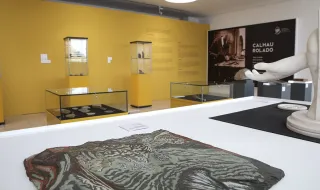
The Museu de Lisboa, at the Palácio Pimenta, hosted an afternoon session where experts Pedro Flor, Paulo Almeida Fernandes and art dealer Philippe Mendes analyzed an oil painting that for decades had been known as "Junot reviewing troops at Rossio", dated around 1800. The temporary exhibition "3 views of Lisbon", which will be open until September 27, presents this anonymous painting alongside two other views of the city from the same period, allowing comparisons between them. During the session, it was revealed to the audience that, although the painting does indeed depict Rossio in Lisbon, the French General Jean-Andoche Junot, announced as the protagonist, does not appear in the canvas.
The article explains that Junot was the general who commanded the French invasion of Portugal in November 1807, having remained in Lisbon for about nine months. Napoleon granted him the title of Duke of Abrantes precisely for having conquered Lisbon, a rare feat in the city's history, which had not been taken since 1147. The session also enabled identification of the statue "Faith trampling Heresy", sculpted by Machado Castro on the pediment of the Inquisition Tribunal, a building that would be demolished a few decades later and which today corresponds to the site where the D. Maria II Theatre stands.
The Museu de Lisboa also possesses another document with the same title, this time a pen-and-ink wash drawing by Luís António Xavier (LAX), which effectively shows Junot on horseback. This Lisbon artist, grandson of a Chinese man from Macau named Alexandre Geraldes, witnessed and recorded in drawing various moments of the French invasion, from the entry of troops in Arroios to Junot's departure from Lisbon in September 1808. LAX thus produced valuable graphic documentation of the occupation, including the Portuguese royal family's departure for Brazil in November 1807, hours before Junot arrived in the city.
In 1947, during the commemorations of the 8th centenary of the Reconquest of Lisbon from the Moors, the anonymous painting was first exhibited to the public at the Museu de Arte Antiga, in Janelas Verdes, having been photographed by Mário Novais for the exhibition catalogue. The work remained unexhibited for nearly a century and a half, with only private owners having access to it. The article notes that despite the apparent lack of a protagonist, the painting offers a wealth of historical details that allow us to understand the Lisbon of 1800 and the transformations the city underwent over the centuries.