The danger of the Portuguese man o' war: how it works and what to do
ScienceSetúbal

The danger of the Portuguese man o' war: how it works and what to do

ZAP Notícias28 August 2026 at 08:00

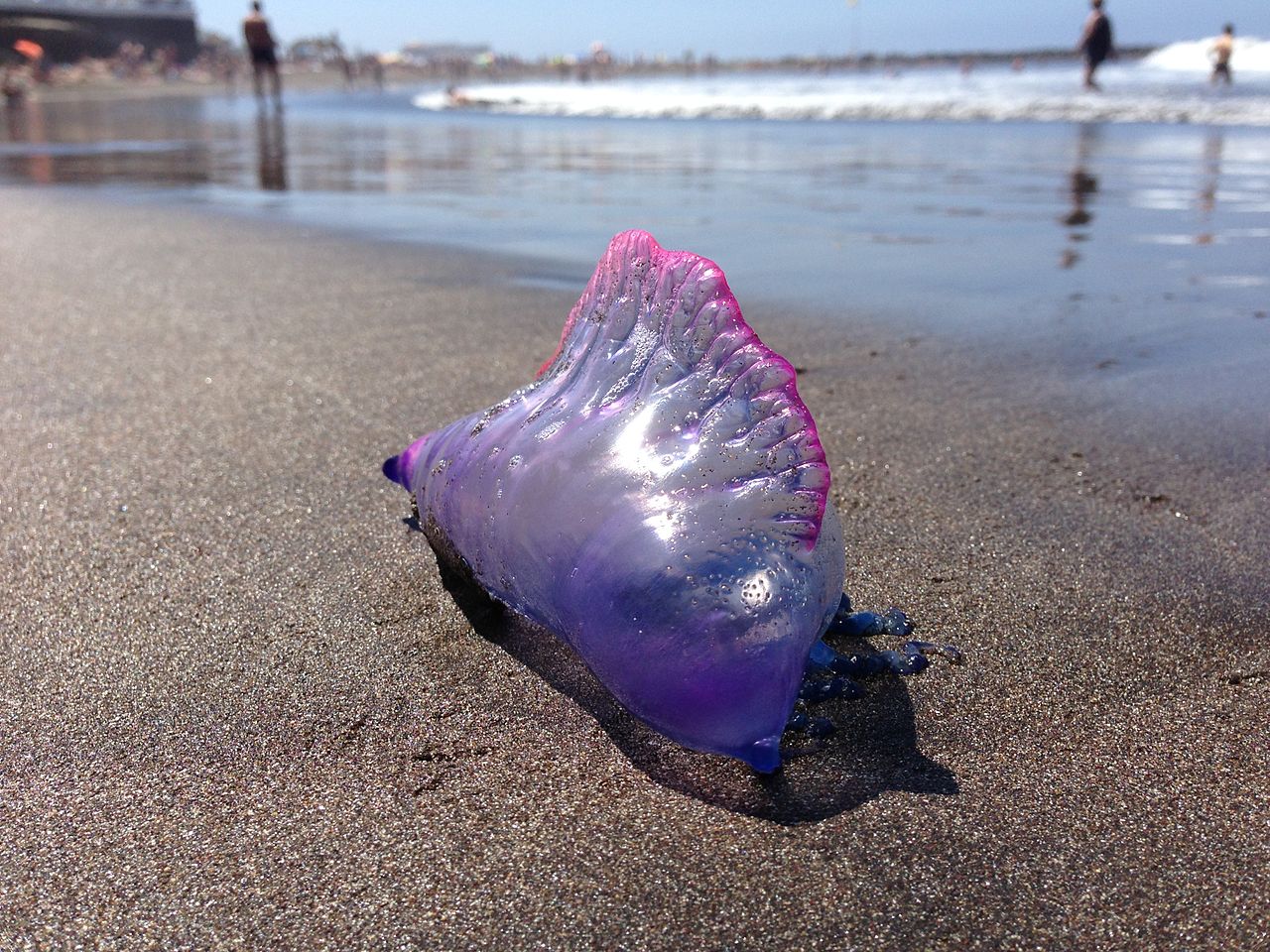
The Portuguese man o' war is a marine organism that can appear on beaches and represents a danger to swimmers. Although it looks very beautiful, its tentacles contain venom and can cause severe burns. The danger is such that even when the man o' war is already dead, its tentacles continue to function and pose a risk.

There is an international standard that indicates the use of purple flags on beaches to alert swimmers to the presence of dangerous marine organisms, including the Portuguese man o' war.

The Portuguese man o' war is not a true jellyfish. It is a colony of small organisms that work together in a coordinated manner. Its structure is blue or purple and resembles a balloon or sail filled with gas that floats on the water's surface, being pushed by wind and ocean currents.


Related articles

Quando a Terra tapou a Lua: as imagens do eclipse lunar pelo mundo
Science

When Earth Covered the Moon: images of the lunar eclipse around the world

After a solar eclipse, it was the Moon's turn to disappear for a few minutes during a lunar eclipse that caught the attention of millions of people in various places around the world. The phenomenon was captured in images that circulated globally.

Correio da Manhã28/08/26, 09:50
Science

Female aging: why the passage of time can generate insecurity?

Vera Fischer, at 74, recently spoke about the fear she felt about aging and the pressure to maintain a youthful appearance, saying she now lives a different relationship with her age. Psychiatrist Camilla Nicolucci comments that social pressure to look young can affect women's self-image, warning that the problem begins when aging is associated with loss of value, beauty, or relevance. The article addresses how, in a society dominated by filters and aesthetic procedures, the marks of time are still treated as something to be corrected, as well as topics like menopause, hormones, and longevity that have gained space in the discussion about female aging.

oglobo28/08/26, 09:05
Science

Global warming intensifies El Niños: new study seeks answers

A new study seeks to understand how global warming is intensifying El Niño events, suggesting that burning fossil fuels may be amplifying this climate phenomenon, making it more frequent and destructive. The research aims to better understand the link between carbon emissions and El Niño's behavior, which has significant impacts worldwide.

Euronews Portugal28/08/26, 09:01
Espécies marinhas invasoras em Portugal aumentaram 75% em 10 anos
Science

Invasive Marine Species in Portugal Increased by 75% in 10 Years

A study by the Center for Marine and Environmental Sciences (Mare) revealed that invasive marine species in Portugal increased by 75% over 10 years. The research, led by Paula Chainho, consisted of an update to a survey of non-indigenous species in Portuguese coastal waters, including estuaries, coastal lagoons, covering both the mainland and the islands.

SAPO Notícias28/08/26, 09:00