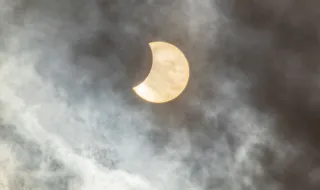
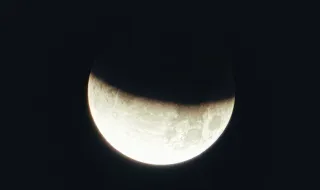
This early morning's partial lunar eclipse can be seen with the naked eyePhoto by Nicola Toscan on Pexels
ScienceÉvora

This early morning's partial lunar eclipse can be seen with the naked eye

DianaFM27 August 2026 at 07:00

In the early morning of August 28, Portugal was able to observe a deep partial lunar eclipse, about two weeks after a solar eclipse. For approximately three hours, the Moon crossed through the Earth's shadow, with the partial phase beginning at 03:33 and the moment of greatest immersion in the umbra (the darkest zone of the Earth's shadow) occurring at 04:13, when almost the entire lunar disk was plunged into darkness.

Related articles

Science

Giant battery to store renewable energy is under our feet</minimax:tool_call>:

Portuguese researchers from the GeoBioTec (FCT-NOVA) and Dom Luiz Institute (FCUL) centers discovered that underground porous rock formations can function as a "giant battery" to store renewable energy on a large scale, powerful enough to supply an entire city.

RTP Notícias27/08/26, 18:10
Science

Eyes on the sky: last partial lunar eclipse of the year happens this early morning

Portugal may observe in the early morning of this Friday, August 28, the last partial lunar eclipse of the year. The phenomenon, which occurs when the Moon partially crosses the shadow projected by Earth, will begin at 2:23 AM with the entry into Earth's penumbra, and the most visible partial phase will begin at 4:12 AM. Earth's shadow will cover part of the lunar surface, altering the appearance of the lunar disk, with the peak of the eclipse occurring near sunrise.

Rádio Campanário27/08/26, 17:49
Science

Lunar eclipse, the dive into emotions</minimax:tool_call>, and may return in the future. The text discusses how a lunar eclipse affects emotions and energy, encouraging introspection and emotional release.

The article describes the lunar eclipse that occurs today, explaining the scientific phenomenon behind the "Blood Moon" — when Earth positions itself between the Sun and the Full Moon, casting its shadow (umbra) on the satellite while sunlight passes through Earth's atmosphere, dispersing the blue tones and leaving only the warmer frequencies that give the reddish hue. The author invites readers to take advantage of this moment to deeply reflect on their emotions.

extra27/08/26, 17:47
Science

How climate change can help explain the disaster in Nepal</minimax:tool_call> output: How climate change can help explain the disaster in Nepal

Filipe Lisboa, climate change specialist, analyzed the disaster that occurred in China and Nepal, which has already caused more than 390 dead and 1,400 missing, linking the event to climate change.

CNN Portugal27/08/26, 17:42